|
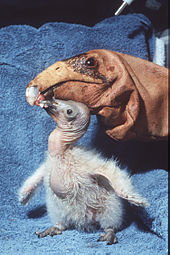
| Photo by USGS photographer Sue Haig |
The San Diego Zoo Safari Park has just announced a new
California Condor cam. You will be able to check in with Sisquoc and Shahtash while they incubate their egg, and barring complications, watch them hatch and rear their chick.
The largest bird in North America, with a wingspan nearing ten feet, these condors are also one of our most endangered species. But, thanks to programs like
San Diego Zoo Global's Condor Conservation, the wild population is once more on the rise, though there are still fewer than 400 known birds in existence.
For this reason, the San Diego Zoo practices careful monitoring and controlled breeding of captive pairs who's offspring might be released back into the wild. The program has successfully released around 80 birds using these methods. It remains one of the most successful captive breed and release programs of endangered species in existence.
Michael Mace, bird curator for the park,
reports that Sisquoc and Shahtash are sitting on an artificial egg while their actual egg is incubated by the staff. Although this is complicated business, much more so than you might imagine, it is also a common practice with a very high success rate. Obviously, few organizations in the world do it better than these people.
I'm sure I've mentioned that for twelve years I was a bird keeper who did some of my own incubating and hand-rearing of endangered birds. About ten years ago, I was fortunate enough to land an internship under one of the San Diego Zoo's outreach programs, the
Keauhou Bird Conservation Center in Hawaii. I learned from the best about the San Diego Zoo's hugely successful incubation rate and their hand-rearing techniques with the endangered A'lala or Hawaii Crow. The program uses many of the same techniques as the Condor Conservation Program, though, unfortunately their release rate has not been nearly as successful.
The image is of a condor chick being hand-fed with a puppet to avoid it imprinting with it's keepers. A'lalas are also fed using similar Hawaii Crow puppets. This feeding technique is often employed when the parent birds or other surrogate birds cannot be found to raise the chicks.
Anyway, what I'm trying to say is you need not fret too much for the egg. It will be in very good hands and safe from many of the things that might prevent it from hatching should it remain in the nest. Early in March, the egg will be returned to the Condors who will be none the wiser, and judging by the established success rate, the birds should accept it back into the fold without incident. They will most likely continue to hatch and care for the chick as if it never left the nest. So for now, expect only to see the occasional swapping of adult birds incubating, and some gentle turning and manipulation of their artificial egg. Mostly, they have a boring job of sitting still and keeping their egg at just the right temperature. The real excitement won't begin for
those of us watching until March, when the egg hatches. I'll be keeping my fingers crossed for the condors and their keepers in hopes of another successful release to the wild.